AI-Ready Apex Trigger Framework: Lean, Bulk-Safe, and Metadata-Driven
An AI-ready Apex Trigger Framework in Salesforce. Learn the architecture, best practices, detailed Apex code, AI prompt templates, and pitfalls to avoid. Designed for scalability, maintainability, and
An AI-ready Apex Trigger Framework in Salesforce. Learn the architecture, best practices, detailed Apex code, AI prompt templates, and pitfalls to avoid. Designed for scalability, maintainability, and AI-assisted development.
Part of the AI-Augmented Salesforce Apex Frameworks series, Foundation Layer
In most Salesforce orgs, triggers are the first Apex code written. They’re also the first to turn messy. Without structure, they get brittle, hard to debug, and dangerous to change.
This post shows how to build an Apex Trigger Framework that:
- Keeps triggers lean and predictable
- Moves logic into reusable handler classes
- Stays bulk-safe and recursion-safe
- Can be toggled on/off via metadata
- Uses clear naming and comments so AI tools can generate and refactor code safely
Why This Framework is AI-Ready
Old trigger patterns were built only for humans. They mixed routing, logic, and config in one file. This framework separates them cleanly so both humans and AI can work with it.
Key reasons it’s AI-friendly:
- Predictable structure. Trigger → Handler → Service → Config. Easy for AI or humans to trace.
- Metadata controls. Enable/disable triggers instantly. No deployments.
- Safe for bulk + recursion. Guard clauses and selectors prevent governor-limit crashes.
- Prompt-ready. Comes with tested AI prompt templates for creating methods, refactoring, and writing tests.
Other Trigger Frameworks:Popular Apex Trigger Frameworks include Kevin O’Hara’s (minimal, widely adopted), Doug Ayers’ (handler class pattern with static context methods), and Andy Fawcett’s Enterprise Patterns (more layered, DDD-inspired). Each has proven itself for traditional Apex development. This AI-Ready variant builds on these strengths and makes it purpose-built for AI-assisted development.
Core Principles
- One trigger per object. Prevents conflicts and unpredictable execution order.
- Handlers own the logic. Triggers only route events.
- Context-aware methods. Separate beforeInsert, afterUpdate, etc. for clarity.
- Bulk-safe. No DML or SOQL inside loops.
- Metadata-driven (optional). Switch triggers on/off instantly.
- AI-friendly patterns. Clear names, consistent parameters, structured comments.
Framework Layers
- Trigger Layer: Routing only.
- Handler Layer: Context-specific business logic.
- Service Layer: Shared utilities and domain methods.
- Config Layer: Metadata toggles for runtime control.
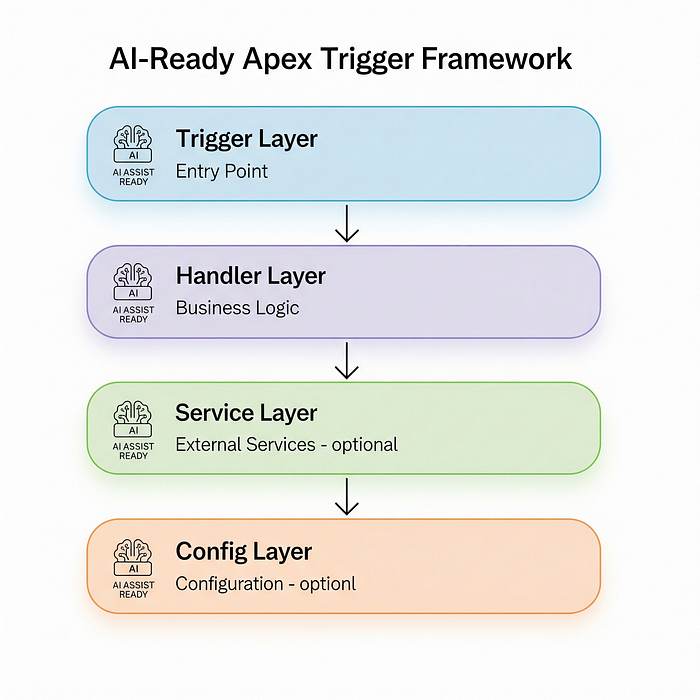
AI-Ready Apex Trigger Framework — layered architecture illustrating Trigger, Handler, Service, and Config layers, each optimized for AI-assisted Salesforce development.
Apex Example: Trigger
One trigger per object, routing only:
CODEBLOCK_0_END
AI Prompt Examples
- Generate a handler method
“For object Case, beforeUpdate: if Status changes from ‘Closed’ to anything else, block it. Return method in AI-Ready Trigger Framework format.” - Refactor a trigger
“Refactor this trigger into the AI-Ready Trigger Framework. Move logic into the handler, add recursion guard, and ensure bulk-safety.” - Write a bulk test class
“Write a test class for AccountTriggerHandler covering beforeInsert defaults, beforeDelete blocking, and afterInsert async job enqueue.”
Pitfalls to Avoid
- Multiple triggers per object
- DML or SOQL inside loops
- No recursion guard
- Hardcoded IDs or field names
- Weak or missing test coverage
Takeaway
This framework gives you a clean baseline: bulk-safe, metadata-driven, and easy for both humans and AI to extend.
For new orgs: make this your default trigger pattern. You’ll avoid recursion issues, stay governor-safe, and give AI tools a structure they can work with.
Next up in the series: Secure CRUD + FLS Wrapper (E) — bringing the same AI-ready approach to Salesforce security.
Appendix A — Full AI-Ready Trigger Framework Reference
A.1 Trigger
Minimal routing. One trigger per object.
CODEBLOCK_1_END
A.2 Recursion Guard Utility
Stops the same trigger logic from running more than once per transaction.
CODEBLOCK_2_END
A.3 Handler Skeleton
Starting point for all trigger logic. One method per context. Bodies are empty until you add your rules.
CODEBLOCK_3_END
A.4 Drop-In Patterns
Optional snippets for common needs. Insert into the handler methods only when required.
- Defaults (beforeInsert): Set missing values.
CODEBLOCK_4_END
- Prevent change (beforeUpdate): Protect critical fields.
CODEBLOCK_5_END
- Block delete (beforeDelete): Enforce dependent record rules.
CODEBLOCK_6_END
- Async work (afterInsert/afterUpdate): Defer heavy or external operations.
CODEBLOCK_7_END
- Change detection (afterUpdate): Trigger work only when a field actually changes.
CODEBLOCK_8_END
A.5 Utility: Change Detection
Reusable helper for comparing old vs. new field values. Keeps update logic clean.
CODEBLOCK_9_END
A.6 Selector Example
Centralizes SOQL. Ensures queries are bulk-safe and easy to maintain.
CODEBLOCK_10_END
A.7 Async Jobs
Queueable jobs for async operations. Use when work is heavy or must run after commit.
CODEBLOCK_11_END
A.8 Config Layer
Uses Custom Metadata to toggle triggers on or off without deployment.
CODEBLOCK_12_END
Appendix B — Expanded AI Prompt Library
- Generate New Handler Method
“For object
_Case_, beforeUpdate: if Status changes from ‘Closed’ to anything else, block it. Return method in AI-Ready Trigger Framework format.”
2. Refactor Existing Trigger
“Refactor this trigger to the AI-Ready Trigger Framework, moving all logic to the handler, adding recursion guard, and ensuring bulk-safety.”
3. Bulk Test Class
“Write a test class for AccountTriggerHandler covering beforeInsert defaults, beforeDelete blocking, and afterInsert async job enqueue.”
4. Performance Audit
“Scan these classes for SOQL/DML in loops, large heap risks, or missing bulk patterns. Return table: Issue | Risk | Fix.”
5. Metadata Toggle Review
“Check that all trigger entry points exit early if TriggerHandlerConfig.isEnabled returns false.”